Tuesday, April 10, 2012

Egypt will run out of water long before 2025

Egypt has long held unrivaled “historic rights” over nearly all of the Nile River’s resources. But now all that could be changing as upstream states like Ethiopia and Burundi seize on Egypt’s post-revolution political uncertainty to finally wrest at least some control of the world’s longest river. The result could be mean dire food and water shortages for Egypt, and maybe another revolution.
Egypt nile water shortages 2012 4 6
Egyptian women walk with containers filled with water in al-Rahawe village, outside of Cairo, on May 27, 2010. Thousands of Egyptians living just a stone's throw from the Nile suffer supply and sanitation problems. (Khaled Desouki/AFP/Getty Images)

Could Egypt run out of water by 2025?

As Egypt loses its grip on the Nile and its population soars, food and water scarcity are becoming a serious problem.


KAFR AL SHEIKH, Egypt and MARAWI, Ethiopia — When construction began on the Nile’s Aswam Dam in 1960, in the southern reaches of Egypt, Egyptians were sure they were about to tame the world's longest river.
“Before the dam, the people’s lives here were much worse. The water would rise and fall without predictability,” said Abdullah Ati, a 42-year-old wheat and clover farmer in the northern agricultural province of Kafr Al Sheikh, relaying his father’s tales from the pre-dam era.
But more than 50 years after Egypt’s firebrand socialist president, Gamal Abdel Nasser, seized on fevered Egyptian nationalism to build the dam and establish the country’s dominance over the Nile, this arid North African nation is facing threats to its near-sole source of freshwater.
With rapid population growth, limited agricultural land and recent challenges to its majority share of Nile waters by upstream states, the United Nations now says Egypt could be water scarce by 2025.
More from GlobalPost: Egypt is losing its grip on the Nile
“In a sense, the average Egyptian is deprived of water,” said Hani Raslan, an expert on water politics at the government-affiliated Al-Ahram Center for Political and Strategic Studies in Cairo.
“The average per capita water use in Egypt is 700 cubic meters [per year], while around the world, it’s about 1,000 cubic meters,” he said. “We are trying to find new sources of water. But soon, [there] will be less than 500 cubic meters.”
It is not that Egyptians are necessarily thirsty. Domestic consumption of freshwater in local households makes up less than 20 percent of the roughly 64 billion cubic meters of water Egypt consumes each year, 55.5 billion of which come from the Nile.
The issue lies in Egypt’s pressing need to feed its exploding population through the expansion and irrigation of the country’s farmland — just 6 percent of its total area —with the same or an even lesser amount of water.
According to the Ministry of Water Resources and Irrigation, Egypt will need 20 percent more water in 2020. Its population, according to government projections, will likely grow from 80 million now to 98.7 million in 2025.
“Egypt is changing, and it has a lot to do with population growth,” said Richard Tutwiler, director of the Desert Development Center at the American University in Cairo, a research facility aimed at serving Egypt’s desert communities. “Everything is irrigated here, yet the water resource has not increased.”
Today, Egypt’s irrigation network draws almost entirely from Nasser’s dam, called the Aswan High Dam, which regulates more than 18,000 miles of canals and sub-canals that push out into the country’s farms adjacent to the river.
The system, however noble in its intentions, is highly inefficient, irrigation experts say. The surface irrigation of crops through the canals, for instance, means as much as 3 billion cubic meters of Nile water is lost each year to evaporation under Egypt’s hot, desert sun.
Also, farmers located at the heads of canals have better access to an abundant supply of quality water than those at the canals’ tails, says Ahmed Al Hennawy, professor of irrigation and soil sciences at Kafr Al Sheikh University.
“The farmers, they take the water from the canal without any planning,” Al Hennawy said. That forces farmers in his village at the end of a canal to use run-off and even sewage water from farming hamlets nearby to irrigate their cotton, rice and corn fields.
“A lot of Egyptians don’t realize we have a lot of water issues,” said Sherif Hosny, CEO of a for-profit company called Schaduf — the German word for a simple agricultural tool used in some of the early gardens of ancient Egypt. His company helps low-income families use hydroponics, a process of growing plants without soil, to establish small gardens on Cairo’s many rooftops.
It’s an irrigation method, Hosny says, that uses 20 percent less water than the current canal system.
“They see the Nile flowing,” he said. “And they think everything is fine.”
More from GlobalPost: Video: Ethiopia claims the Nile
Having the Nile as the solitary source of freshwater was once a blessing for Egypt’s rulers, enabling the pharaohs and subsequent governments to forge a centralized system of administration and infrastructure anchored in the river and its adjacent communities.
But now, to ease over-crowding near the river, Egypt’s government is encouraging its swollen population to move away from the Nile and into the desert — which makes up 95 percent of its area. About half of Egypt’s 80 million people live in the fertile Nile Delta north of Cairo.
The government is offering tracts of sandy wasteland at low-cost if settlers pledge to irrigate the barren parcels.
The Egyptian government has managed to boost its tillable land over the last 50 years by one-quarter, using canals to bring Nile water to the desert. But most of those plots were snatched up by commercial mega-farms that churn out cash crops — like strawberries — for export rather than local consumption. In the end, these green desert farms did little to ease the scarcity of food in Egypt.
“The policy for 60 years has been to expand the cultivated surface of Egypt, getting people out of the valley and into the desert,” Tutwiler said. “But it’s a different environment out there. The drainage issues are different. And the irrigation, it needs more power. It involves a much higher capital investment that poor farmers just don’t have.”
Indeed, blooming the desert requires funds to build modern irrigation systems capable of pumping water, with energy-fueled, pressurized pipes, out of the Nile Valley.
While it helps alleviate pressure on the Nile Delta, experts say the desert irrigation program only reduces Egypt’s ability to conserve water.
“Think about Egypt as kind of a valley. Gravity suggests if you put too much water on your field in upper [southern] Egypt, it trickles back into the Nile, and you can put it back on a field in lower [northern] Egypt,” said Tutwiler, describing the flood irrigation system that originates at the Aswan Dam in the south.
“But if you take the water out of the valley and put it in the desert, it doesn’t go back into the Nile. It’s lost in the sand.”
Heba Habib contributed reporting for this article from Cairo, Egypt.
http://www.globalpost.com/dispatch/news/regions/middle-east/egypt/120406/could-egypt-run-out-water-2025

Sunday, April 1, 2012

Shared Benefits and Responsibilities in the Nile Basin


A Common Vision for a Better Future for All Stakeholders

The Nile Basin have many benefits but to attain them there are many challenges in the road which  each of the basin countries have a responsibility  and a role to play in overcoming them. In promotion of this Concept, the Eastern Nile Basin Discourse Forum in cooperation with SNDF (Sudan National Discourse Forum) has organized a two day Workshop on 19 and 20th February, 2012; under the theme of Shared Benefits and Shared Responsibilities. It was attended by members from non-governmental organizations (NGOs) and Media from the five countries of the Eastern Nile Basin Countries; Sudan, Ethiopia, Egypt, Eritrea and the new state of State of South Sudan.
The opening session was addressed by the Sudan Minister of Irrigation and Water Resources and many officials of Eastern Nile Basin countries Discourse forums .Many presentations were made during the two days of the Forum with the aim to come to a shared vision based on the general consensus between all the countries on how to share the benefits of the resources of the Nile and at the same time share the responsibilities of the development and sustainability of these resources.
In the end of the Forum, all participants agreed on a Position Paper which reads as follow:

------------------------------------

The Nile Basin Discourse (NBD) is a regional network of civil society organizations established to facilitate and support civil society engagement in Nile Basin Cooperation and development processes in pursuing our shared vision. Engagement is facilitated by the regional secretariat based in Uganda and through National Discourse Forums (NDFs) in each of the 11 countries (Burundi, the Democratic Republic of Congo, Egypt, Eritrea, Ethiopia, Kenya, Rwanda, Sudan, South Sudan Tanzania and Uganda), which currently have a total of over 750 civil society member organizations across the region.

Civil Society Representatives and experts from EN sub-region met at Khartoum Sub-regional Multi-Stakeholders’ Forum on 19 -20 February, 2012  to  raise awareness on the shared benefits of coordinated development and utilization of shared water resources and emphasize on the importance of community participation in the Nile Basin projects .


The Sub-regional Forum observed that the EN sub-region’s position on the Nile is critically important because they are the drivers of the Nile Cooperation and Development process.

The Sub regional forum stress that the existing activities of CSO  provides impact on the grass root of NB citizens and provides an opportunity  to enhance the EN cooperation.

The Sub regional Forum recognized the importance of benefits sharing mechanism and the need to draw lessons from other basins in cooperation with ENTRO


The NBD is CONCERNED of the following:

On the role of state and non state actors in water resources management and development in Nile basin
* The importance of adequate sharing of the information at all levels to empower the local community to sustain the Nile basin Resources
* The  importance of gender mainstreaming the Nile basin development projects and within the institutional process of NBI and NBD
The role of ENTRO in supporting the Nile basin development projects and  process and collaborating with NBD to ensure wide stakeholder  participation ion in Nile basin activities
On Institutionalization of community participation and livelihood concerns in the Nile Basin projects

* Training and capacity building from NBI , international partners to enable NBDs and NDFs to fully participate in project decision making process
* Introduce water resources management measures and environmental impact assessment
* Creating favourable environment for community participation and livelihood concerns
* Allocate more funds for carrying out evidence based research
* Call for the adoption of clear policy provisions on benefit sharing mechanisms to local communities
* Lessons leant and success stories along the Nile Basin (e.g. success stories in water harvesting in Kenya and Rwanda) need to be documented and distributed by ENTRO for the state and non state actors
Introduce Watershed Resources Management Measures and Environmental Impact Assessment.
* Build the Capacity to Undertake Watershed Management:
* Obtain outside sources of funds to initiate community activities.
* Information Management and Knowledge Sharing:.
* Importance of linkages between Watershed issues and Food security, Agriculture and the MDGs


On Promotion of Benefit and Cost sharing to foster EN Trans-boundary cooperation:
Build on success stories and lessons learnt and Develop criteria and mechanisms for benefit sharing

Saturday, March 31, 2012

Ethiopia's plantations are killing vital waterway - Survival International

Efforts to re-direct the Omo River for irrigation are drying up a key water source for tribes.
© Survival

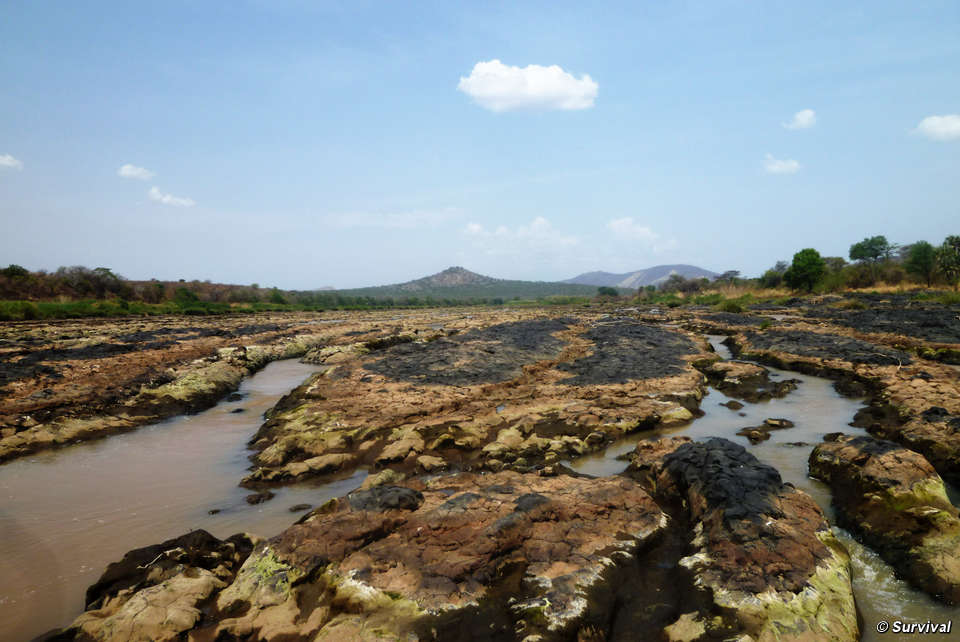
New photographic evidence proves Ethiopia’s controversial plantations scheme is killing the Lower Omo River, a lifeline for 100,000 tribal people.
The Omo River downstream from the notorious Gibe III dam is now being diverted into a newly-dug irrigation canal, one of several which will feed a massively ambitious plantations scheme for state and private investors. 
These manmade canals are key to Ethiopia’s plantations plan, which is already having a hugely negative impact on UNESCO’s Lower Omo World Heritage site.
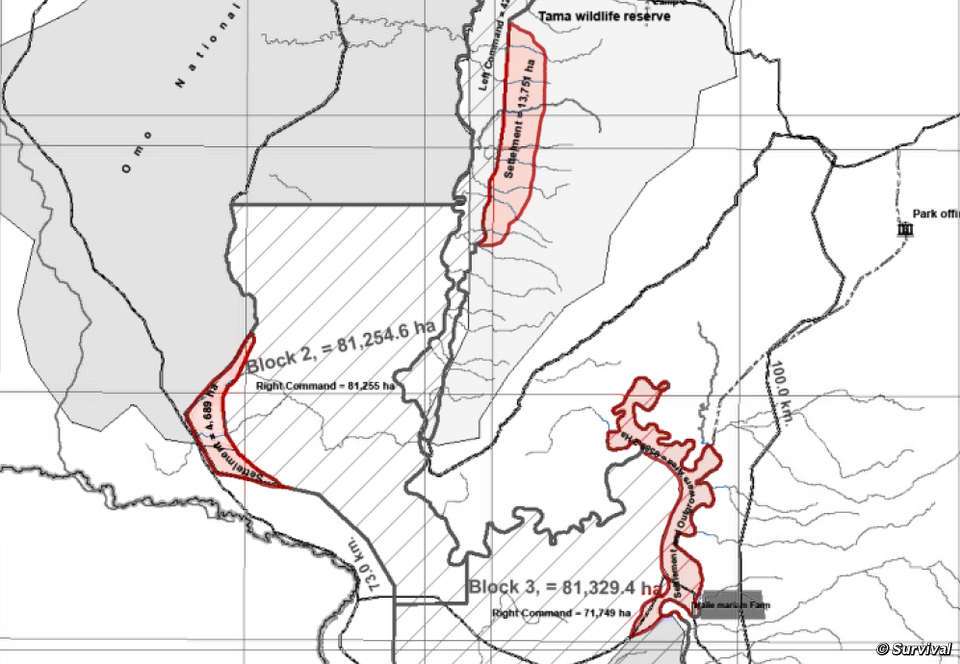
The government has revealed virtually nothing about the plantations program, but an official map obtained by Survival shows the enormous scope of the project.
A copy of the leaked Ethiopia map. Survival has highlighted the three resettlement areas.
© Survival
One local person, speaking to a Survival researcher who recently visited the area, said, ‘I’ve never seen the river this low. During the dry season, like it is now, you can usually cross by foot, and water reaches your knees. Now I could cross without my feet getting wet.’
The Gibe III dam, 200 kms upstream, will interrupt the river’s natural flow and deprive thousands of tribespeople of their most valuable agricultural land by stopping the annual flood.
The flooding of the Omo River feeds the rich biodiversity of the region and ensures tribes such as the Bodi, Mursi and Dassanach can feed their cattle and produce beans and cerealsin the fertile silt left behind.
There was a flood last year, but most Bodi and Mursi were not able to use it for cultivation because of the irrigation project. There will be no flood this year, as the dam reservoir starts to fill, nor in succeeding years. The people have been told they will be given food aid in compensation.
Two Karo boys in front of a full Omo River. Water levels are now unrecognizably low.
© Survival
Indigenous communities are also suffering from violent human rights abuses, as plans are implemented forcibly to resettle those who stand in the way of the government’s plans, and to take away their cattle.
Survival’s Director Stephen Corry said today, ‘Ethiopia’s government is destroying the Lower Omo Valley and the livelihoods of tens of thousands of indigenous people – all in the name of ‘development’. However the human cost cannot be ignored. Re-directing a water lifeline is irresponsible and reckless.’
Note to Editors:
Kenya has recently finalized a deal, which will see it importing electricity generated from Ethiopia’s Gibe III dam.
Enhanced by Zemanta

Sunday, March 25, 2012

Irrigation minister flies to Addis Ababa for discussions over Nile dam | Egypt Independent

Irrigation minister flies to Addis Ababa for discussions over Nile dam

Sun, 25/03/2012 - 15:00
<p>Blue Nile in Ethiopia</p>
Photographed by other
Irrigation and Water Resources Minister Hesham Mohamed Qandil left Sunday for Addis Ababa for a visit that will last for few days. He will meet with the water ministers of Egypt, Sudan and Ethiopia.
The meetings will tackle the future of water resources in the three countries. Arrangements will be made for contracting four international experts, chosen by a committee formed by the three governments to evaluate the construction of the Grand Ethiopian Renaissance Dam — formerly known as the Grand Millennium Nile Dam — on the Blue Nile.
Qandil said the Ethiopian side will provide technical studies and information about the dam when the contracts are signed so that the committee can start work.
The committee’s work will last around six months, the minister said. It aims to reach a comprehensive evaluation of the procedures the Ethiopian government must undertake to face the negative impacts of the dam.
In April, Ethiopia began work for the construction of the Nile dam, which triggered Egyptian fears that the dam would affect Egypt’s historical share of Nile water.
Egypt, according to a treaty signed with Sudan under the British occupation, is entitled to 55.5 billion cubic meters a year Nile’s flow of around 84 billion cubic meters. According to the treaty, any country wishing to establish any agrarian project must first seek Egypt’s approval.
But Nile Basin countries, including Ethiopia, Kenya, Rwanda, Uganda and Tanzania, signed an agreement in Entebbe in May 2010 that sought a fair redistribution of water shares. This has rattled Egypt and Sudan, upstream countries that enjoy the lion’s share of river water, and brought further tensions between Nile River countries.